Summer Shorts Vol. 1: Stickers and Boomers
Writing shorter doesn't equal writing easier but I gotta do something

Overstimulation is a thing. You feel it in Summer when the kids are home all day everyday.1 You feel it when your to do list is only growing and not shrinking, but your brain feels very busy, but you aren’t getting anything done, but you’re tired. And you feel it when there are constantly earbuds and someone else’s voice in your head, filling you with great information or good entertainment but too much of everything.
I was feeling it yesterday. I have a book coming out in October and a list of never-done-before things to learn and do in regards to releasing a book, a desire to keep writing every day even when I’m busy-brained, and long-learned wisdom that reminds me big things happen in small increments.
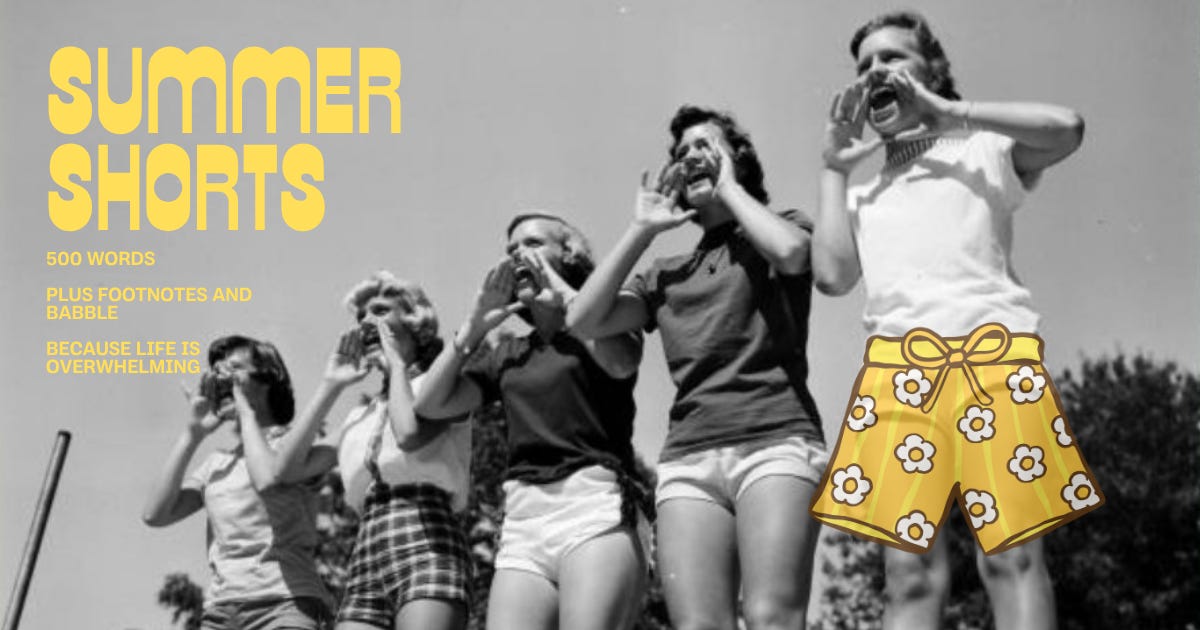
The idea came to mind that I could limit my Substack essays for the summer to just 500 words, as a way to lessen the pressure on both of us—I don’t have to write long posts; you don’t feel the weight of reading long posts.
Mark Twain supposedly said something like “I didn’t have time to write a short letter, so I wrote a long one instead.” The internet will argue with the attribution, but the sentiment remains true. Why would I think limiting myself to 500 words would be easier?
I don’t know, but in an effort to stop dismissing my internal dialogue, I am going for it. I will call it Summer Shorts. You can copy me if you’d like because there are no original ideas and I probably heard this from someone else somewhere, sometime.
The essay portion will be exactly 500 words, but I give myself freedom to babble in an intro like thus and to use footnotes to my heart’s content, and those words do not count towards the 500. My rules.
Here begins Vol. 1:
Downstairs I’m reading “Uprooted” by Grace Olmstead. She writes about stickers and boomers, those who stick around their hometowns and put down roots that last for generations, and those who feel called to bigger and better things beyond rural living. She is a boomer, leaving Idaho for schooling and a job on the east coast, but she is writing this book to figure it out, to discover if she ought to return to her roots. The book came out in 2021 and I’m sure she’s figured it out by now, but I’m only halfway through so no spoilers.
The stickers stay and keep the traditions of their parents and grandparents and great-grandparents, trying to make their living from the land. Olmstead includes plenty of research and history on farming practices and migrations to Emmett, Idaho, and there are many reasons it’s harder than it used to be. The land itself bears the scars of unsustainable practices and “advancements” that require undoing if the soil, water, and air are to produce healthy food and livestock, let alone people.
My own book was written in the place I’ve lived most my life in. We just celebrated 30 years of marriage, which means almost 30 years of Camas Valley. But when my book comes out this Fall we will have been gone from that town and the place my stories are rooted in for over a year. We haven’t gone far and we’re still in a small town, but we are uprooted nonetheless and the feeling of unsettledness is tiring. We don’t think this is the place we’ll stay. It’s beyond beautiful (More Beautiful Than Necessary, really), but it’s a long drive to our work and our people. I’ve written about some of our reasons for moving but it would take much more than 500 words to give the story justice.2
Upstairs at bedtime I am reading “Life, and Death, and Giants”, a novel by Ron Rindo about a boy-giant named Gabriel and the Amish family and English townsfolk trying to raise him. I’m a quarter of the way through but the story is just starting to grab me. I don’t have any 6’4” nine-year-olds in my life, but the religion and secrets and rumors of rural Lakota, Wisconsin, are familiar to me. The way the community comes together, the way individuals take responsibility for a child, the poverty and pastimes of the people—those are familiar.
Each chapter is titled for a different character and in Part 1, two of those characters are speaking in first person and one is not. Hannah tells her story. Billy tells his. But someone else is telling Thomas Kennedy’s story.
Thomas is an outsider. At this point in the story, that’s the only reason I can come up with for why his chapters are third person. Hannah and Billy are stickers, having lived in the same town all their lives, but Thomas came later.
In Camas Valley, it takes twenty years before you are considered “from here”.
If you’ve been around here awhile you know we homeschooled our kids, so “all day everyday” was regular life. But I can appreciate the difference between “kids at home with no regular schedule”, aka, Summer; and “kids at home with plenty of structure and then forced outdoor time”, aka, Homeschooling.
Honey, the graphic alone for Summer Shorts is worth it to be here.
Your wit and wisdom shine through everything....this Boomer thanks you.
Here we are the midlife transition, and I'm praying for us what I pray for my kids and our parents a prayer from Praying the Scriptures for Your Children: Lord, you know where we should live and where we should move. Lead us to that appointed place. It's taking some pressure off. As always, thanks for your words.